Selecting the appropriate after-school activity for your child may be more challenging than it seems. As parents, you want your child not only to have an experience that helps them grow and flourish, but also to develop the character that enables them to succeed in life. The choices are unlimited: they can include competitive team sports, academic tutoring, music classes, or other physical activities such as dance and gymnastics. Nevertheless, there is one area that has been extremely comprehensive in its approach to child development: Karate.
At LBKI Budokan, we see firsthand the transformative power of traditional karate. It is not merely a martial art. It is an established method of creating success that extends far beyond the four walls of the dojo. Comparing long-range, compounding benefits of karate with the other usual activities, one realises that there is a distinctive and unequivocal path in karate in terms of aiding children to prosper in all areas of their lives.
The cultivation of character: Individual growth VS Team dynamics
Group activities such as rugby, football, or netball are also popular alternatives for children. These activities can teach cooperation and social skills, but they often struggle to fit in the one thing every child requires.
The power of individual development
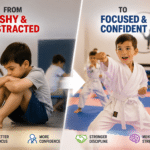
In team sports, a child’s development and self-esteem can be directly traced to a team’s success or failure, or to a coach’s selection bias. A shy or less physically developed child may spend more time on the bench, feeling overpowered or responsible for their team’s loss. The competitiveness, at times, can cause performance anxiety and prevent a child from being self-assured.
Karate operates on personal progress. The failure of one student does not depend on another student’s success. Every class is a competition between students and their own past selves. When a child performs a kata (a sequence of movements) or manages to master a complex technique, the achievement is entirely their own. This focus on personal growth builds a deep, inner confidence, known as self-efficacy, which is crucial for tackling challenges in school and later in life.
Discipline and respect are an essential foundation
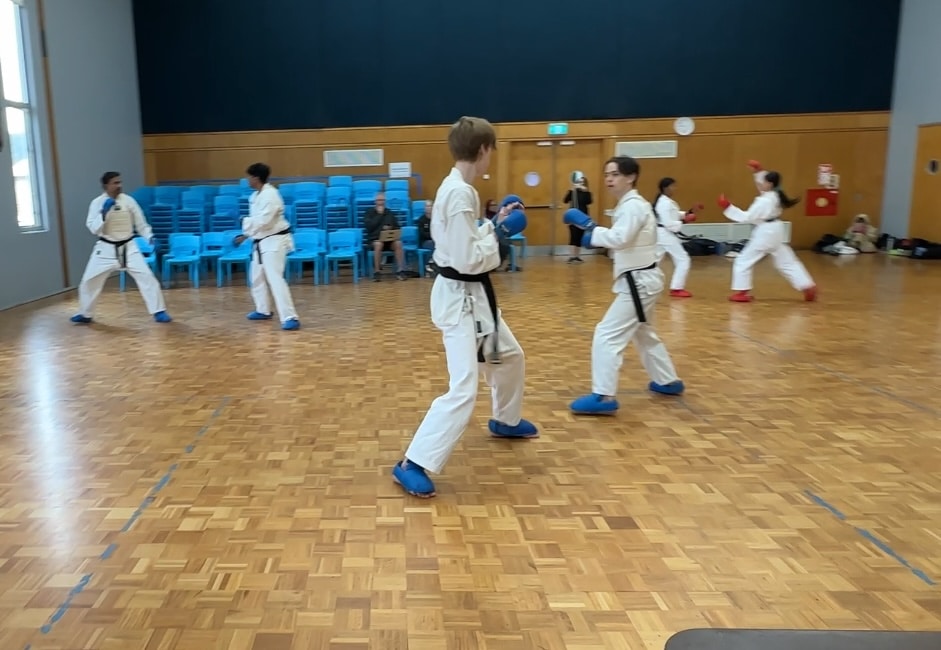
While team sports teach rules and cooperation, the foundation of traditional karate is respect (Rei). From the moment a student bows upon entering the dojo, they are about a culture that values humility, self-control, and discipline. Students learn to follow instructions precisely, respect their instructors (Sensei), and support their peers.
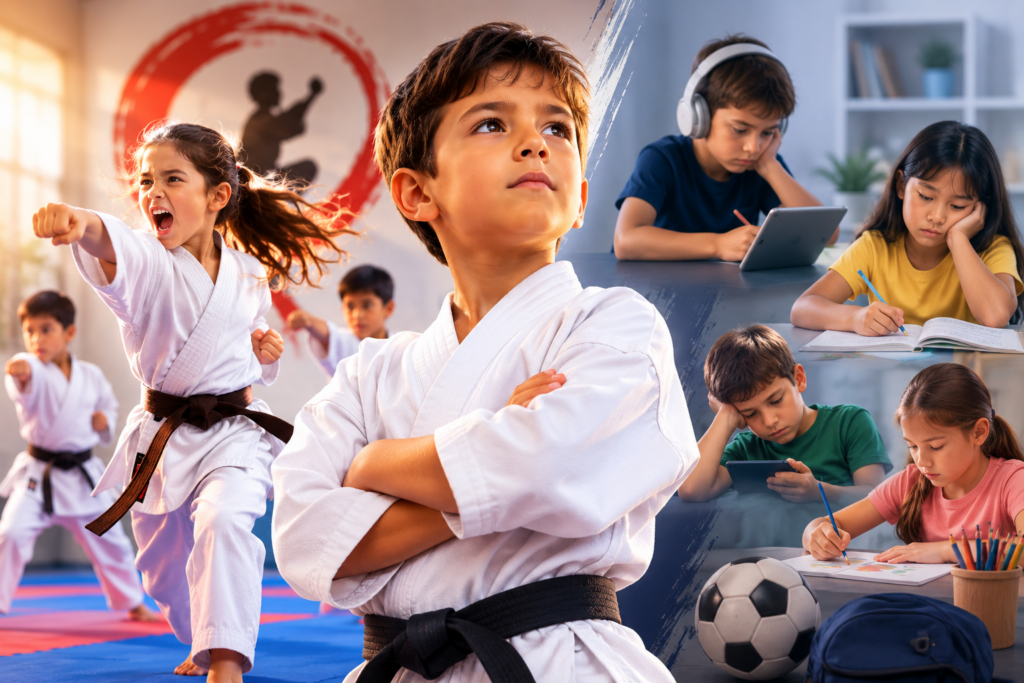
This structured environment teaches children to control their impulses, be focused, and be present in the moment. The ability to listen carefully and execute a plan is a skill that directly transfers to the classroom, often leading to improved academic concentration and performance. This personal discipline is something a child owns, carrying it with them into every situation, unlike the group discipline of following a coach’s strategy during a match.
Physical mastery and holistic health
Many after-school activities provide physical fitness, but few provide the comprehensive, all-around physical and mental conditioning that karate delivers.
Beyond sport-specific fitness
Team sports typically focus on a specific skill set: running endurance in soccer, throwing strength in cricket, or hand-eye coordination in basketball. Karate, particularly the style taught at LBKI, provides your child with a complete, full-body workout that is unparalleled in developing fundamental athleticism.
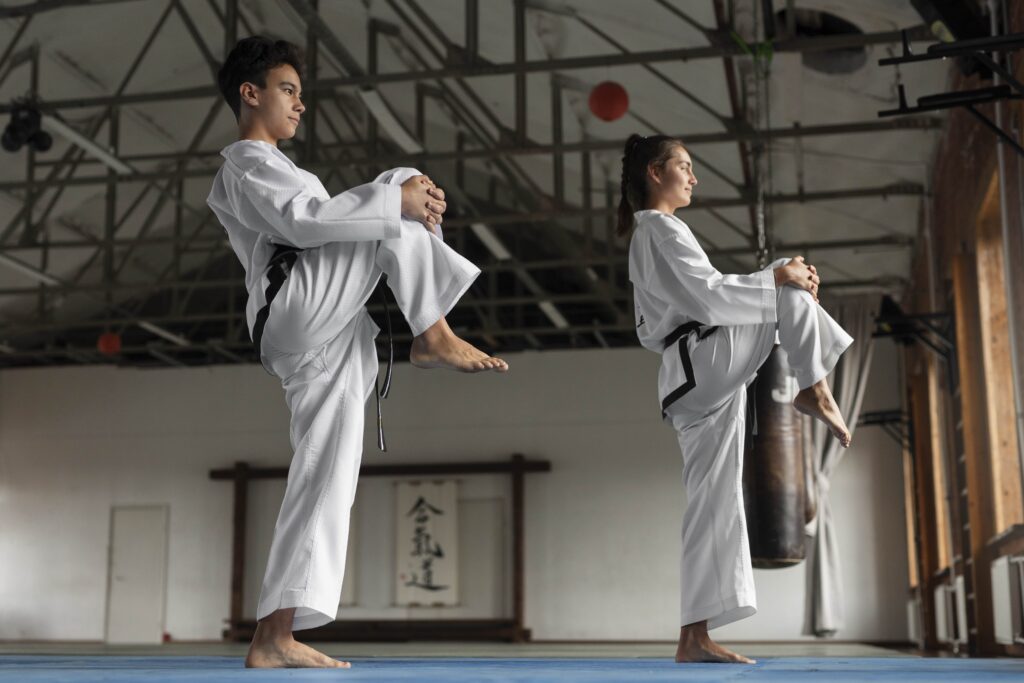
Through the continuous practice of stances, blocks, kicks, and strikes, children can develop:
- Coordination and balance: Mastering forms requires intense body awareness and spatial reasoning.
- Strength and flexibility: Dynamic movements build core strength and increase overall range of motion.
- Cardiovascular health: Training drills and sparring build stamina.
This diverse physical training ensures that children develop into well-rounded athletes.
Focus and resilience
In today’s digital age, where children are constantly bombarded with digital stimuli, sustained mental focus and attention span are significant developmental benefits. Karate demands concentration.
Additionally, karate develops perseverance. The belt system is a concrete symbol of perseverance. It teaches students that great successes need constant work and a commitment to keep trying. When a youngster fails to pass a grade, they learn to view the setback as a challenge that can be solved with hard work. As students endure and eventually achieve the next belt, the sense of victory strengthens their conviction in their capacity to conquer any obstacle.
Why choose karate over the other arts?
While other martial arts also offer significant benefits, traditional karate emphasises character in a way that is often overlooked in more sports-focused combat systems.
Kickboxing, for instance, is highly effective for fitness and striking, but it was primarily developed as a competitive sport. Traditional karate is rooted in self-defence and philosophy. It uses physical training as a vehicle for mental and ethical growth.
Self-Defence and Conflict Resolution
Parents often choose martial arts for self-defence, but the most actual benefit of karate is not the ability to fight, but the ability to avoid a fight.
Karate gives children self-defence skills, physical prowess, and the courage to resist bullying. More importantly, it can teach conflict resolution, reinforcing the idea that acquired skills should be used as a final resort. The field also inculcates the ability to control emotions, enabling students to do so in the middle of a stressful situation by staying composed and focused, ensuring that conflicts are resolved amicably and respectfully. Karate emphasises non-violence and emotional control, a character pillar that many other physical activities do not.
Goal Setting for Life
Setting goals is highly effective when paired with a visual, incremental approach, such as the belt system. The Karate journey does not end in a month, as the season of one sport does, but over a period of years, with many milestones that can be attained. The stripes, the belts, are all the rewards of hard work, not the product of a winning score. This ongoing self-paced program will keep the children motivated and realise that hard work is a reward in itself.